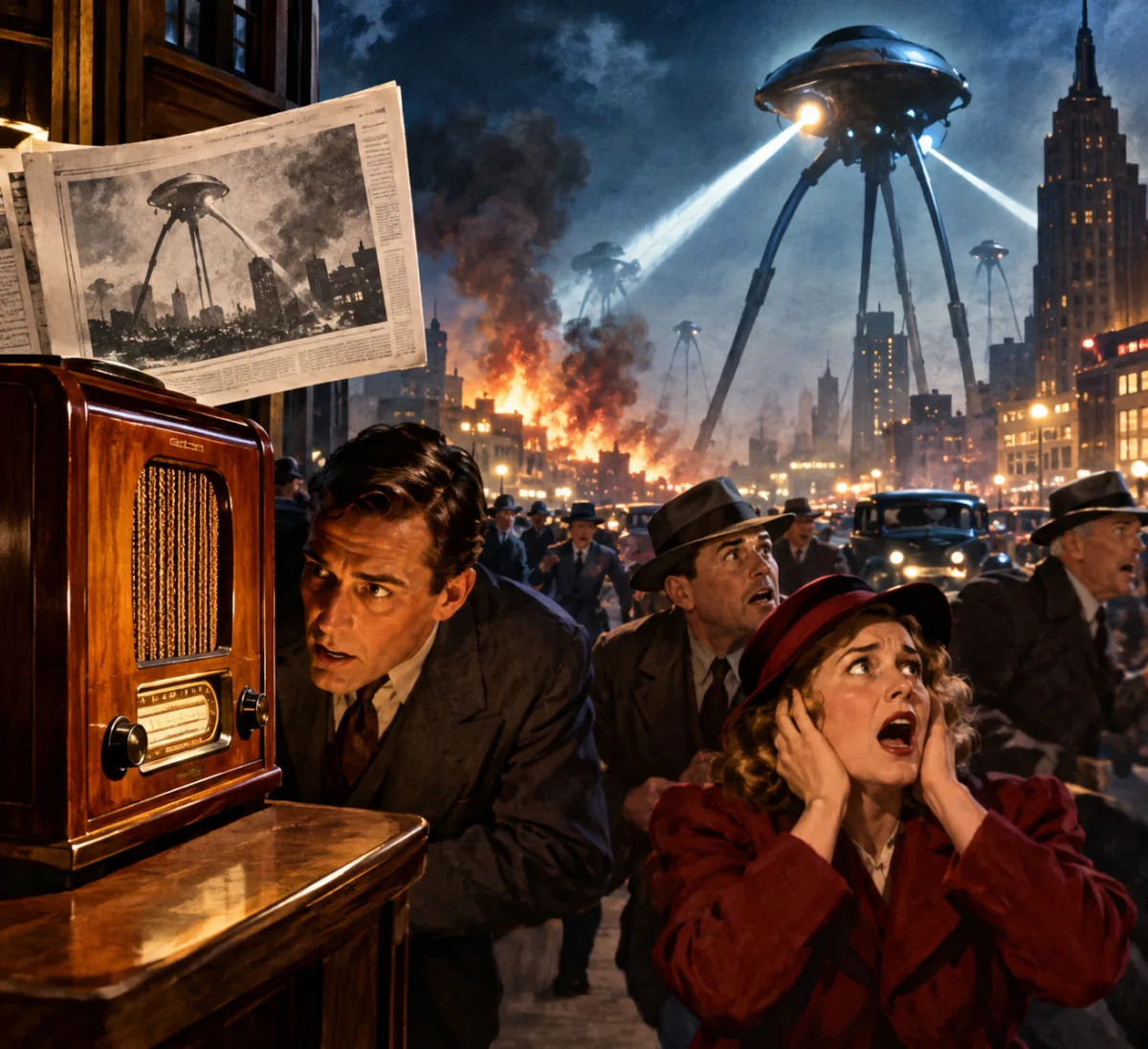
Within his program The Mercury Theatre on the Air, the young director Orson Welles presented a radio adaptation of H. G. Wells's novel The War of the Worlds. What mattered was not the material itself but the form. Welles, together with a team of scriptwriters and sound technicians, transformed the classic science-fiction narrative into a series of seemingly authentic live inserts that resembled real news reporting.
What the Fake Invasion Looked Like
The broadcast began inconspicuously. After an introduction and the presentation of the orchestra came a report about strange explosions on Mars, delivered by an actor in the role of an astronomer. This was followed by an interruption of the music and a fictional report about a strange object that had landed on a farm in Grovers Mill, New Jersey. The reporter on the scene described the crater, curious neighbors, and suddenly also a moving creature inside a metal cylinder.
The sound effects were masterful: hissing, metallic blows, screams, an interrupted signal. In the role of the reporter, the actor Frank Readick managed to convey terror so convincingly that listeners felt as if they were right there on the spot. When the report suddenly fell silent, the voice of another correspondent came on with a warning that Martian war machines were moving across the countryside, destroying everything in their path.
"Ladies and gentlemen, this is not a drill. I repeat, this is not a drill." This sentence sounded so urgent on the radio that many Americans believed it was a real catastrophe.
The Panic That Gripped the Cities
In many cases, the public reaction was dramatic. People ran out of their homes with wet handkerchiefs over their mouths because they believed the air was poisoned by Martian gas. Others packed their bags, filled their cars, and tried to leave the cities. Police and newspaper switchboards were overwhelmed with callers seeking information about the invasion and asking what they should do.
In some areas, traffic jams formed, people gathered in churches to pray, and some complained of headaches or breathing difficulties that they attributed to "Martian gas." There are also accounts of people who set out for the supposed farm in Grovers Mill to see the invasion with their own eyes.
The panic was not universal – many listeners recognized the play or realized it was theater. Nevertheless, the number of confused and frightened people is estimated at thousands to tens of thousands. It was precisely this fact that turned the broadcast into a legend.
Why People Believed It
The success of the hoax had several causes. In 1938, radio was the main source of fast news, and people trusted it much as they trust the internet today. The format of live inserts and interrupted bulletins matched the way radio reported on real crises, such as the Hindenburg airship disaster or floods.
The times also played an important role. The world was recovering from the Great Depression, and tensions in Europe were growing ahead of the Second World War. The Munich Agreement had been signed only a month before the broadcast, and fear of war was present in American society. A story about a sudden, devastating attack thus fit into an existing anxiety.
- Trust in the medium: radio was perceived as an immediate and reliable source.
- Realistic form: fake reports, sound effects, and an interrupted program.
- The circumstances of the time: pre-war tension and concerns about security.
- The crowd effect: neighbors and acquaintances passed the panic on to one another.
Consequences and Myths
The very next day, newspapers were flooded with headlines about the "panic from Mars." At a press conference, Orson Welles had to explain that it had been a theatrical play, and he apologized to everyone who had been frightened. Paradoxically, the broadcast brought him enormous publicity and helped him on his way to Hollywood, where a few years later he made the film Citizen Kane.
Later research showed that the extent of the panic was somewhat exaggerated in the contemporary press. Newspapers had their own interest in portraying radio as an unreliable and dangerous medium. Nevertheless, it remains a fact that thousands of people reacted in confusion and some genuinely believed that Martians had invaded Earth.
To this day, the case is used as a textbook example of the power of the media, the influence of form on the perception of content, and how easily a realistic presentation can shift the boundary between fiction and reality. In the era of disinformation and viral news on social media, the story of October 30, 1938, is still relevant.
The War of the Worlds did not convince Americans of the existence of Martians. It did, however, show how fragile the boundary between trust and fear is – and how much it matters in what form a story is told.