Cold War Context and the Arms Race
The Ivy Mike test was not an isolated event. It took place at the height of the rivalry between the United States and the Soviet Union. After the USSR successfully tested its first atomic bomb in 1949, the United States lost its monopoly on nuclear weapons. American scientists and military strategists therefore began working on a new generation of weapon that would use nuclear fusion – the same principle that powers the Sun.
The project was led by a team of physicists headed by Edward Teller and Stanisław Ulam, who came up with the key concept of staged construction. This made it possible to separate the primary fission trigger from the secondary fusion section and thus achieve unprecedented energy.
How the Explosion Unfolded
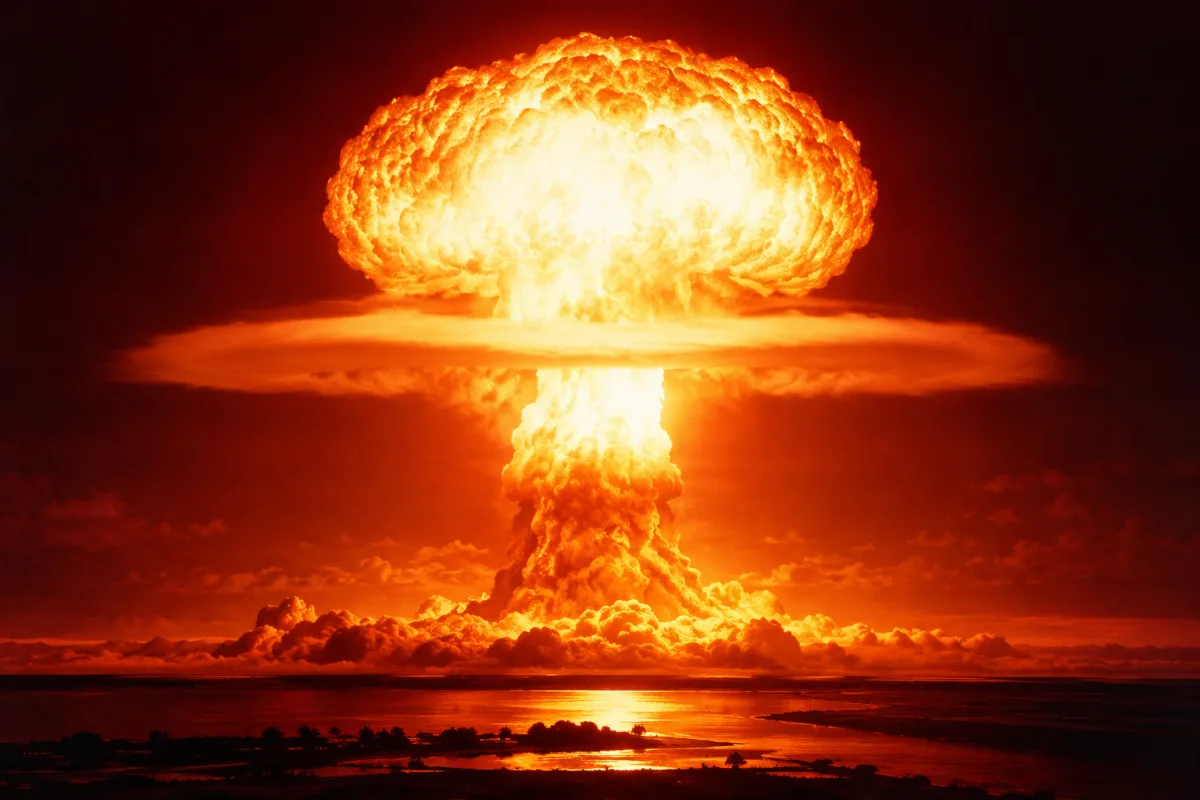
The device was not designed as a usable weapon. It was a large experimental object weighing over 80 tons, filled with liquid deuterium and tritium, which was placed in a laboratory building on the island of Elugelab. The explosion on November 1, 1952, at 7:15 local time created a fireball several kilometers in diameter and a column of water and steam that rose to a height of tens of kilometers.
The consequences were dramatic:
- the island of Elugelab, with an area of approximately 1.5 km², was completely destroyed, and in its place remained a crater over 50 meters deep,
- the Eniwetok Atoll was hit by a pressure wave and radioactive fallout,
- the surrounding coral reefs were severely damaged,
- fish and marine animals over a wide area died as a result of the shock wave and radiation.
Significance and Consequences of the Test
Ivy Mike proved that a thermonuclear weapon was technically feasible and opened the way to the development of much more compact and usable hydrogen bombs. As early as 1954, the United States tested the Castle Bravo bomb, which was smaller but exceeded expectations in its power and caused extensive radioactive contamination.
The test also launched a new phase of the arms race. The Soviet Union responded with its own thermonuclear test as early as August 1953, and other countries – Great Britain, France, and later China – followed. The world entered an era in which humanity, for the first time in history, found itself in a situation where it could destroy itself.
"Now we know that we have let the genie out of the bottle. The question is not whether we can put it back, but whether we can live with its presence."
These words, attributed to one of the project participants, capture the atmosphere that prevailed after the test. Scientists and politicians alike realized that the nature of international security had changed.
The Legacy of Operation Ivy Mike
Operation Ivy Mike is a symbol of technological progress as well as a moral dilemma. It showed what human reason is capable of, but at the same time revealed the fragility of the balance on which the survival of civilization depends. Today, more than seventy years after the explosion, international treaties limiting nuclear weapons exist, yet the world still carries the legacy of this first thermonuclear test.
For the Marshall Islands, the legacy of the tests remains painful – inhabitants were displaced from their homes, and part of the territory is still radioactively contaminated today. Ivy Mike is thus not only a chapter in physics textbooks but also a reminder of the responsibility that every discovery entails.